
When someone passes away, families often hear the word “probate” before they really understand what it means. It can sound formal, intimidating, and expensive. For many people, the biggest fear is not knowing what is supposed to happen next.
In Georgia, probate is the court process used to recognize a Will, appoint someone to handle the estate, or appoint someone to administer the estate if there is no Will. The person appointed may be called an Executor if there is a Will or an Administrator if there is no Will. More generally, that person is often called the Personal Representative.
Probate does not always look the same in every case. The steps depend on whether there is a Will, whether the heirs agree, what assets exist, whether creditors are involved, and whether the estate needs formal administration. Still, most Georgia probate matters follow a general path.
Step 1: Determine Whether Probate Is Actually Needed
The first question is not “How do we file probate?” The first question is “Do we need probate at all?”
Some assets may pass outside of probate. Examples can include accounts with named beneficiaries, jointly owned property with rights of survivorship, life insurance payable to a beneficiary, retirement accounts, or assets held in a properly funded trust.
Other assets may require probate, especially if the deceased person owned property in their individual name with no beneficiary or survivorship designation.
This is why it is so important to look at how each asset is titled. A Will does not automatically avoid probate in Georgia. MYTH ALERT!
In many cases, the Will is the document that must be presented to the Probate Court so the nominated Executor can be officially appointed.
Step 2: Locate the Original Will
If there is a Will, the original matters.
Families often find copies in a drawer, binder, email, or safe. Copies can be helpful for information, but the Probate Court usually wants the original signed Will. The person named as Executor in the Will is typically the person who starts the probate process.
If no original Will can be found, the process may become more complicated. The family may need to determine whether a copy can be used, whether the Will is presumed revoked, or whether the estate should proceed as if there is no Will.
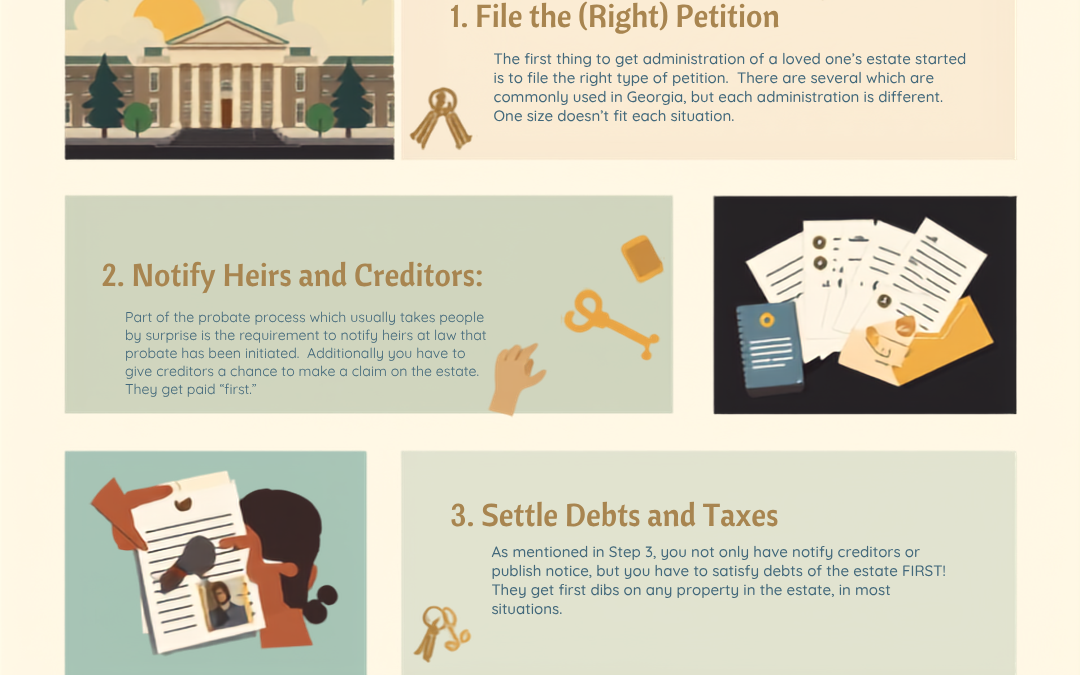
Step 3: Identify the Correct Probate Petition
Georgia uses standard probate court forms, and the type of petition depends on the situation. Common estate forms include a Petition to Probate Will in Solemn Form, a Petition for Letters of Administration when there is no Will, a Petition for Year’s Support, and a Petition for Discharge of Personal Representative. Here is the link to go to the forms: https://www.gasupreme.us/probate-court-standard-forms/
If there is a Will, many families use probate in solemn form because it provides notice to the heirs and becomes binding once completed. If there is no Will, the process is usually an administration, and the court appoints an Administrator rather than an Executor.
The right petition matters because filing the wrong form or leaving out required information can create delays.
Step 4: File in the Correct County
Probate is generally filed in the Probate Court of the county where the deceased person was domiciled at death. In simple terms, that usually means the county where they legally lived.
For example, if the person lived in Fulton County, the probate matter would usually be filed with the Fulton County Probate Court. Fulton County, like other Georgia counties, provides access to commonly used decedent estate forms, including petitions for temporary letters, letters of administration, probate in common form, and probate in solemn form. (Fulton County Probate Court)
County procedures can vary. Some courts require appointments. Some have specific filing instructions. Some move faster than others. The forms may be statewide, but local practice still matters.
Step 5: Give Notice to the Proper People
This is one of the places where families are often surprised.
Even if there is a Will, the heirs-at-law may still be entitled to notice. Heirs-at-law are the people who would inherit if there were no Will. That may not be the same group of people named in the Will. Here are two great videos to check out to see the definition of an heir, https://youtu.be/0P-Xtl9xK7Y?si=qeJrKfzLPC-Tbpo4, and difference between a beneficiary and an heir, https://youtu.be/S8ubC9LnAYE?si=qaykfhwUUSNrW7Vp.
For solemn form probate, notice is required to the heirs-at-law, and minor or incapacitated heirs may require appointment of a Guardian ad Litem, most commonly referred to as a GAL. A GAL cannot be avoided in almost all instances where a minor is involved.
This step can slow things down if heirs are difficult to locate, live out of state, do not respond, or disagree with the Will.
Step 6: Wait for the Court to Review and Appoint Someone
Once the petition is filed and notice issues are handled, the Probate Court reviews the filing. If everything is in order and there are no objections, the court may issue an order appointing the Executor or Administrator. There are specific steps this person needs to take, like swear an oath, present identification. It isn’t immediate. MYTH ALERT! Until this point, absolutely no person has any authority to make formal legal decisions to what happens, sign contracts, or usually talk to financial institutions.
The appointment is what gives the Personal Representative authority to act.
Before that appointment, family members should be careful. Being named in a Will does not automatically give someone authority to access accounts, sell property, or distribute assets. The authority comes from the court order and the Letters Testamentary or Letters of Administration.
Step 7: Use the Court-Issued Letters to Begin Administration
After appointment, the Personal Representative receives official proof of authority. If there is a Will, these are commonly called Letters Testamentary. If there is no Will, they are commonly called Letters of Administration.
These Letters allow the Personal Representative to work with banks, financial institutions, buyers, real estate professionals, and others who need proof that someone has legal authority to act on behalf of the estate.
This is often the point where the practical work really begins.
Step 8: Identify, Protect, and Manage Estate Assets
The Personal Representative must identify estate assets, protect them, and manage them appropriately. This can include securing real estate, opening an estate account, collecting funds, identifying debts, reviewing mail, maintaining insurance, and keeping records.
This is not the time to casually divide property.
Even when everyone gets along, the Personal Representative should keep clear records of what comes in, what goes out, and why. Good records help prevent confusion and protect the person serving in that role.
Step 9: Address Creditors, Expenses, and Taxes
Before beneficiaries receive distributions, the estate’s obligations must be addressed. This may include funeral expenses, final bills, medical expenses, credit cards, property expenses, taxes, and costs of administration.
Not every bill should be paid immediately, and not every creditor claim is valid. The Personal Representative should understand the estate’s debts and priorities before making payments.
This is one reason distributing assets too early can create problems. If money is given out before debts and expenses are handled, the Personal Representative may have difficulty getting funds back.
Step 10: Distribute Assets to the Proper Beneficiaries or Heirs
After assets are collected and obligations are addressed, the Personal Representative can work toward distribution.
If there is a Will, distributions should follow the Will. If there is no Will, distributions generally follow Georgia intestacy law, which determines who inherits when someone dies without a Will. Here is a great video on what this means: https://youtu.be/io1xxSwMr_s?si=7_t3SxqO-5LfTxsP
This step may involve transferring funds, signing documents, selling property, or distributing personal property. It should be done carefully and with records.
Step 11: Close the Estate
The final step is closing the estate.
In many Georgia cases, this may involve a Petition for Discharge of Personal Representative. Georgia’s standard probate forms include a Petition for Discharge, which is commonly used when the Personal Representative is ready to be released from further responsibility. (gasupreme.us)
Discharge matters because it formally ends the Personal Representative’s role and can provide protection from future questions or claims related to the administration.
What Families Should Remember
Probate in Georgia is not just one filing. It is a process.
It often begins with determining whether probate is needed, locating the Will, filing the correct petition, giving notice, waiting for appointment, collecting assets, addressing debts, distributing property, and closing the estate.
The process can be straightforward when documents are clear, heirs cooperate, and assets are simple. It can become more complicated when there is no Will, family conflict, missing heirs, creditor issues, real estate, minor beneficiaries, or uncertainty about ownership.
Most families do not need to know every probate rule on day one. They need to know the next right step.
If someone you love has passed away and you are unsure whether probate is required in Georgia, whether a Will needs to be filed, or what authority you have to act, getting clear guidance early can prevent delays and avoid mistakes.
Atlanta Wills + Trusts Law Group helps Georgia families understand what probate requires and what steps come next.