
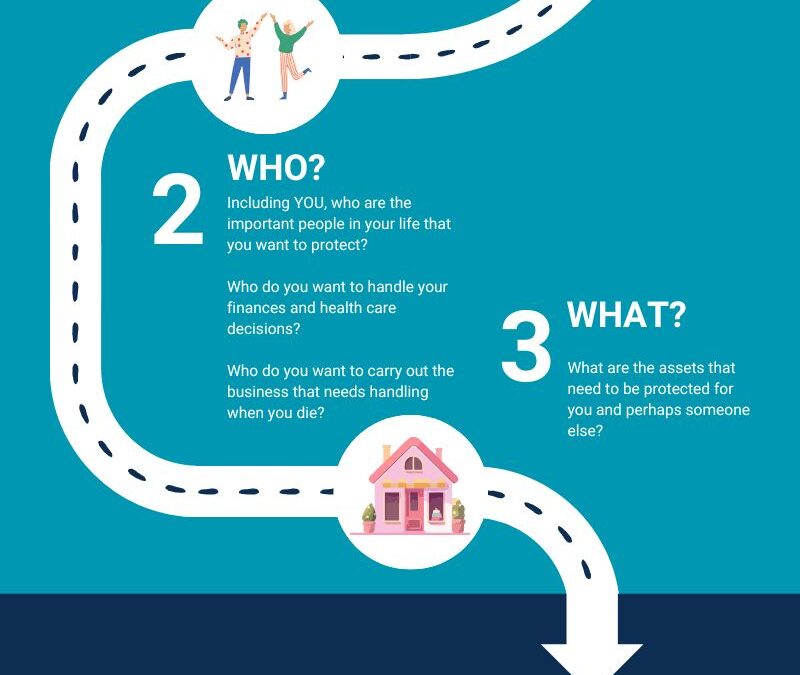
When people think about estate planning, they often assume we are talking about documents — wills, trusts, powers of attorney. But before any document is drafted, there is a more foundational conversation that has to happen.
What do you own, and how do you own it?
Estate planning is, at its core, a conversation about ownership.
Not just net worth. Not just tax exposure. Not just complex financial structures.
Ownership.
And ownership looks different for every woman.
Ownership Is Personal
One woman may have a checking account, a savings account, and a retirement plan. Another may have those same accounts plus a high-yield savings account, a money market fund, brokerage investments, restricted stock, or deferred compensation. Someone else may own a primary residence, a rental property, or an interest in a professional practice. Another may hold digital assets, cryptocurrency, or intellectual property tied to her career.
Every one of these assets carries a title. Every title determines what happens next.
The structure of ownership — not just the existence of an asset — controls whether something transfers automatically, passes through probate, or flows through a trust.
But there is another category of ownership that is often overlooked because it does not show up on a statement.
Personal property.
Personal Property Is Still Ownership
When we talk about ownership, we are not just talking about bank accounts and brokerage accounts. We are also talking about the tangible things that fill your life.
Jewelry.
Artwork.
Family heirlooms.
Furniture.
Collections.
Vehicles.
Sentimental items passed down through generations.
For some women, personal property may not represent significant financial value. For others, it may be substantial. But regardless of market value, personal property often carries emotional weight.
It is frequently the source of the most tension after someone passes away.
Financial accounts can be divided by percentages. Personal items cannot.
Who receives grandmother’s ring?
Who keeps the original artwork?
Who inherits the dining table where holidays were hosted for twenty years?
Without direction, families are left to negotiate. And negotiation during grief is rarely easy.
Estate planning allows you to be specific. You can create lists. You can leave written instructions. You can direct certain items to certain people. You can reduce the risk of misunderstanding or resentment. You can ensure that sentimental items go where they will be valued most.
Ownership includes the personal.
The Title Still Controls the Outcome
For financial assets, ownership is about titling and designation. A checking account may be individually owned or jointly owned. A savings account may have a payable-on-death designation. A retirement account passes by beneficiary designation, not by will unless coordinated properly.
Real estate transfers based on how it is titled. A home owned solely in your name will move differently than one held jointly or in trust.
Business interests and professional equity are governed by operating agreements and shareholder restrictions. Brokerage accounts may have transfer-on-death designations.
In each case, the outcome is determined by ownership structure.
But personal property, unless otherwise specified, often flows under the general provisions of a will or trust. That means clarity in drafting becomes critical.
The documents must match the ownership reality.
Ownership Reflects Your Life Story
For many professional women — attorneys, financial advisors, physicians, executives — ownership reflects years of work, independence, and intentional decision-making. Yet in traditional planning environments, conversations sometimes focus narrowly on the financial statements without fully integrating the personal context.
A high-achieving woman’s ownership structure may include investment accounts, retirement plans, real estate, and equity interests. It may also include carefully curated art, inherited jewelry, or collections built over decades.
All of it is ownership.
And all of it deserves coordination.
Estate planning should not treat personal property as an afterthought. Nor should it assume that financial assets alone define your legacy. Both matter. Both require thought.
Ownership Determines Smoothness
When ownership is aligned with your intentions, transitions are smoother. Accounts transfer according to designations. Property moves according to structure. Personal items are distributed according to clear instructions.
When ownership and planning are disconnected, confusion follows. Accounts may be frozen. Probate may be required unnecessarily. Personal property may become a source of disagreement.
Estate planning is not about having more; it is about aligning what you have.
The Question to Consider
If you made a list today of everything you own — your checking account, your high-yield savings account, your money market fund, your retirement plan, your home, your business interest, your jewelry, your artwork, your vehicles, your digital assets — would you know how each one transfers?
Would someone else?
Estate planning begins with clarity about ownership. It continues with coordination. It ends with peace of mind.
Because ultimately, what we are really talking about is not just assets on paper. We are talking about the tangible and intangible pieces of a life you have built.
Ownership tells that story.
Planning ensures it transitions the way you intended.